Turmimax Bio
Pre-clinical research

Cellular & animal studies

Cell-based experiments and animal models have investigated the biological mechanisms behind Turmimax® BIO - inflammatory cytokines, oedema, cartilage structure, extracellular matrix proteins and tissue-degrading enzymes.

Anti-inflammatory activity in macrophages & animal models

Model

LPS-stimulated RAW 264.7 macrophages · croton oil-induced ear oedema (mice) · histamine-induced paw oedema (rats)

Findings
  • Substantial reduction of IL-8 and IL-12 expression in LPS-activated macrophages compared with LPS-only cells.
  • Not cytotoxic to RAW 264.7 cells at concentrations up to 50 µg/mL under study conditions.
  • 58.65% inhibition of croton-oil ear oedema at 2 h and 57.25% at 4 h (200 mg/kg).
  • Dose-dependent reduction of histamine paw oedema, comparable to diclofenac reference at several measurements.
Anti-Inflammatory & Edema Model Data
Click to enlarge
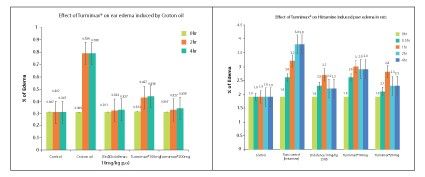
Croton Oil Ear Edema (Mice) & Histamine Paw Edema (Rats)

Croton Oil Ear Edema (Mice) & Histamine Paw Edema (Rats)

Turmimax® BIO demonstrated significant inhibition of croton oil-induced ear edema (58.65% at 2 h and 57.25% at 4 h at 200 mg/kg) and dose-dependent reduction of histamine-induced paw edema, demonstrating effective anti-inflammatory activity.
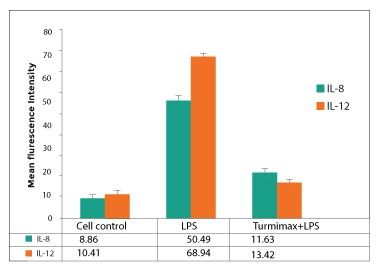
Anti-Inflammatory Activity & Cytokine Suppression

Anti-Inflammatory Activity & Cytokine Suppression

Turmimax® BIO effectively reduces inflammation by suppressing IL-8 and IL-12 expression, inhibiting pro-inflammatory cytokine production, and targeting the NF-κB pathway in LPS-stimulated macrophages.

Firoz Hussain H. M. et al. American Journal of Biochemistry and Biotechnology. 2022;18(4):386–393. DOI: 10.3844/ajbbsp.2022.386.393Read full paper ↗
In-vitro water dispersibility & bioavailability profile

Model

In-vitro dissolution, dispersion stability & comparative absorption assays

Findings
  • Delivers over 95% total curcuminoids in a 100% water-dispersible format.
  • Dissolves quickly and maintains dispersion stability over time without rapid sedimentation.
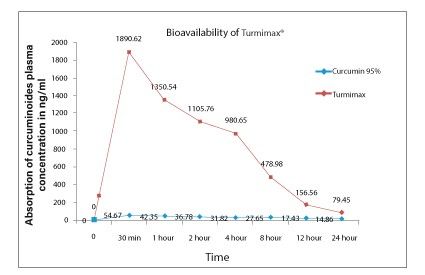
  • Delivers up to 35× higher bioavailability and significantly higher absorption compared to standard 95% curcumin extract.
In-Vitro Dispersion & Bioavailability Data
Click to enlarge
Comparative Dispersibility & 35× Bioavailability Profile

Comparative Dispersibility & 35× Bioavailability Profile

Turmimax® BIO is a water-dispersible curcuma delivering over 95% curcuminoids – dissolving quickly and maintaining dispersibility over time, resulting in a product that is 35× more bioavailable and significantly higher in absorption compared to standard 95% curcumin.

Star Hi Herbs R&D Technical & Bioavailability Dossier

In-vitro antioxidant & free-radical scavenging activity

Model

DPPH free-radical scavenging & lipid peroxidation inhibition assays vs BHT reference

Findings
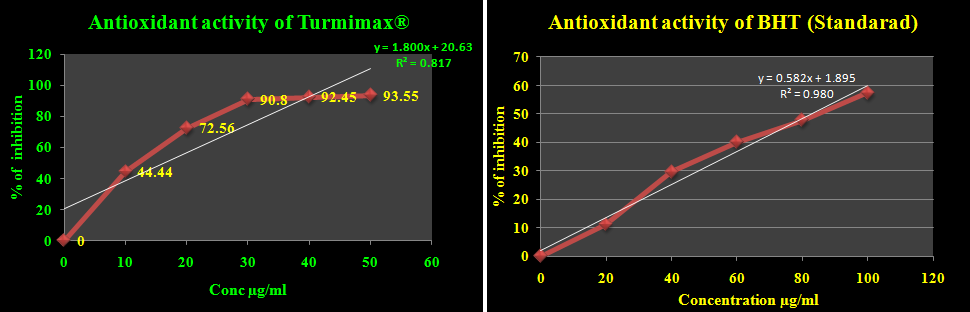
  • Exhibits powerful antioxidant activity, scavenging free radicals and inhibiting lipid peroxidation.
  • Reported IC50 value of 82.19 µg/mL in DPPH radical scavenging assay.
  • Reported IC50 value of 16.31 µg/mL in lipid peroxidation assay compared to standard BHT.
In-Vitro Antioxidant Assay Data
Click to enlarge
Free Radical Scavenging & Lipid Peroxidation IC50 Activity

Free Radical Scavenging & Lipid Peroxidation IC50 Activity

Turmimax® BIO exhibits powerful antioxidant activity, scavenging free radicals and lipid peroxidation with IC50 values of 82.19 and 16.31 µg/mL compared to standard BHT reference.

Firoz Hussain H. M. et al. American Journal of Biochemistry and Biotechnology. 2022;18(4):386–393.Read full paper ↗

Cartilage protection in an osteoarthritis model

Model

Monosodium iodoacetate (MIA)-induced knee osteoarthritis in rats

Findings
  • Dose-dependent reduction of knee-joint swelling.
  • Micro-CT improvements in bone volume fraction, trabecular number and thickness in higher-dose groups.
  • Reduced articular cartilage damage; increased COL2A1 (type II collagen) and aggrecan expression.
  • Reduced iNOS, COX-2, 5-LOX and IL-1β, IL-6, TNF-α in synovium; reduced MMP-2, -3, -9 and -13.
In-Vivo Histology, Micro-CT & Immunohistochemistry Data
Click to enlarge
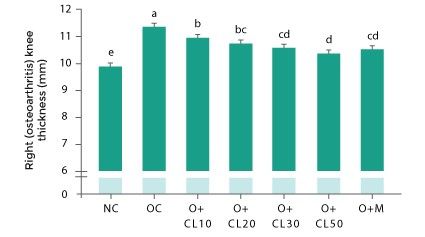
Knee Joint Swelling Reduction

Knee Joint Swelling Reduction

The knee joint was thicker in the OA group compared to the NC group, but CLE (Turmimax® BIO) orally reduced it in a dose-dependent manner, effectively alleviating swelling symptoms caused by OA.

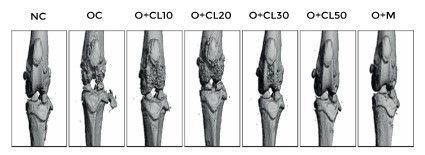
Articular Cartilage Degradation & Micro-CT Bone Indices

Articular Cartilage Degradation & Micro-CT Bone Indices

The OC group exhibited greater knee joint erosion and reduced bone parameters (BV/TV, Tb.N, Tb.Th) compared to the NC group. CLE (Turmimax® BIO) administration dose-dependently alleviated bone erosion and improved these indices, with higher doses (O+CL30, O+CL50) restoring them to levels comparable to the positive control (O+M).

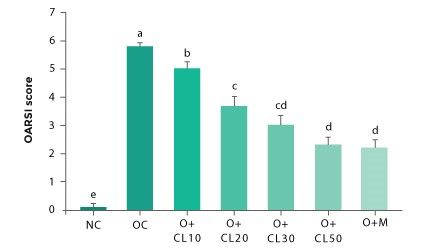
OARSI Severity Score

OARSI Severity Score

The OARSI score for OA severity was significantly higher in the OC group, but CLE-treated groups (O+CL10 to O+CL50) and the O+M group showed significantly lower scores, indicating alleviated cartilage damage.

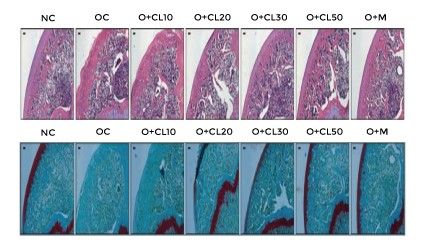
Cartilage Morphology & Safranin O Staining

Cartilage Morphology & Safranin O Staining

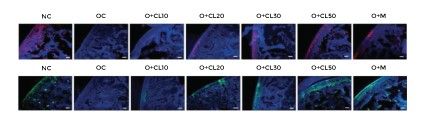
A) The NC group showed well-preserved cartilage, while the OC group showed deformed and damaged cartilage. CLE administration alleviated cartilage damage, with the O+CL30 and O+CL50 groups showing similar morphology. B) Safranin O staining showed no tissue deformation in the NC group, while the OC group had severe cartilage damage and proteoglycan loss.

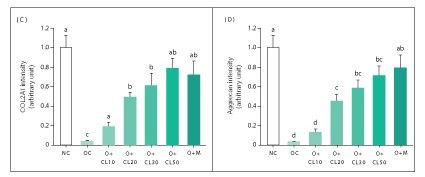
COL2A1 Expression in Knee Articular Cartilage

COL2A1 Expression in Knee Articular Cartilage

COL2A1 (type II collagen) expression was significantly lower in the OC group compared to the NC group, but increased dose-dependently following CLE (Turmimax® BIO) administration, indicating preservation of cartilage structural proteins.

Aggrecan Expression in Knee Articular Cartilage

Aggrecan Expression in Knee Articular Cartilage

Aggrecan expression was significantly lower in the OC group compared to the NC group, but increased dose-dependently by CLE (Turmimax® BIO) administration even at low concentrations, indicating protective effects on the cartilage extracellular matrix.

Lee HS, Jung JI, Hur N, Bae J, Lee JK, Kim E. Anti-osteoarthritis effect of a standardized Curcuma longa extract in monosodium iodoacetate-induced osteoarthritis rats. Nutr Res Pract. 2025 Aug;19(4):537-553.Read full paper ↗

Antiproliferative & apoptosis-related cellular activity

Model

HeLa human cervical adenocarcinoma cell line, in vitro

Findings
  • Concentration-dependent inhibition of HeLa proliferation with IC50 of 87.89 µg/mL at 24 h.
  • Cell viability declined from 80.60% at 6.25 µg/mL to 45.86% at 100 µg/mL.
  • Flow cytometry showed increased apoptosis at IC50; cell-cycle arrest involving G0/G1 and S phases.
  • Preliminary; not evidence that Turmimax® BIO prevents, treats or cures cancer.
H. M. Firoz, S. Nanjundaiah, C. T. Sadashiva, B. Neethumol, Y. Rashmi and A. K. Sreedrisya. Antiproliferative activity and apoptosis-inducing mechanism of Curcuma longa (Turmimax®) on HeLa cell lines. Brazilian Journal of Biology. 2023, vol. 83, e275953.Read full paper ↗

Acute toxicological evaluation

Model

Acute oral toxicity, up to 2,000 mg/kg body weight

Findings
  • No mortality at the highest tested dose.
  • No acute toxic symptoms observed.
  • No significant changes in body weight, physiological responses or food intake.
Toxicology report
Get started

Formulate with Turmimax® BIO

Request a sample, specification, clinical dossier or commercial quotation from our ingredient team.